Friday, August 10, 2018

THE CHEST


Incline Barbell Press
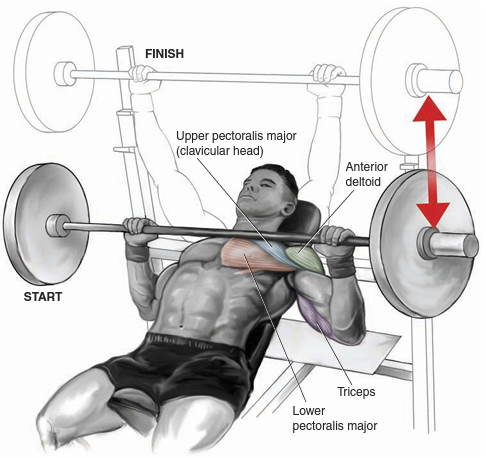
incline barbell press
Execution
1. While seated on an incline bench, take a shoulder-width overhand grip on the bar.
2. Lower the weight slowly until the bar touches your upper chest.
3. Push the bar straight up until your elbows lock out.
Muscles Involved
Primary: Upper pectoralis major.
Secondary: Anterior deltoid, triceps.
Anatomic Focus
Trajectory: The angle of incline determines trajectory. As the backrest is raised up and the incline increases, the focus shifts progressively higher up the pectoral muscle. The upper pectoral is best targeted when the backrest is inclined at 30 to 45 degrees to the fl oor. Steeper inclines of 60 degrees or more switch the focus to the anterior deltoid.
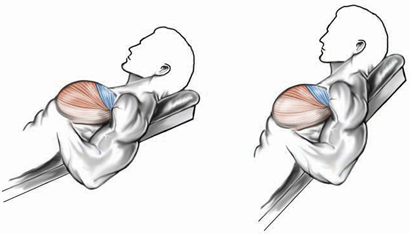
incline shifts pectoral muscle
Hand spacing: A shoulder-width grip or slightly wider targets all areas of the upper pectoral muscle. Narrow hand spacing emphasizes the inner central portion of the chest and requires more effort from the triceps. Wider grips provide a greater stretch, targeting the outer portion of the muscle, and minimize triceps contribution; but as the hand spacing increases, so does the risk of injury.
Range of motion: To maximize pectoral work, fl are your elbows out wide as the barbell is lowered. A shorter rep terminating the press just before lockout keeps tension on the pectorals and reduces triceps assistance.
VARIATION
Machine incline press: This provides better stability and safety than the standard barbell press. Many machines offer a choice of grips. A neutral grip (thumbs up, palms facing together) emphasizes the pectorals better than a pronated grip (palms forward).

Incline Dumbbell Press
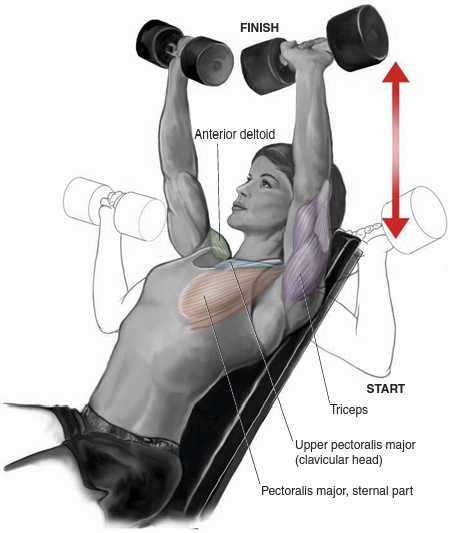
incline dembbell press
Execution
1. While seated on an incline bench, start with the dumbbells at chest level, palms facing forward.
2. Press dumbbells vertically upward until elbows lock out.
3. Lower dumbbells back down to your upper chest.
Muscles Involved
Primary: Upper pectoralis major.
Secondary: Anterior deltoid, triceps.
Anatomic Focus
Trajectory: The angle of incline determines trajectory. As the backrest is raised up and the incline increases, the focus shifts progressively higher up the pectoral muscle. The upper pectoral is best targeted when the backrest is inclined at 30 to 45 degrees to the fl oor. Steeper inclines of 60 degrees or more switch the focus to the anterior deltoid.
Grip: Dumbbell orientation affects hand position. Grasping the dumbbells with a pronated grip (palms facing forward) affords a greater stretch as the weight is lowered to the start position. A neutral grip (palms facing together) generates a better contraction at the lockout position.
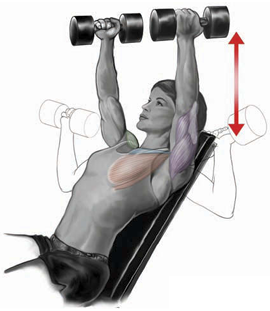
neutral grip at lockout
Range of motion: To maximize pectoral work, fl are your elbows out wide as the dumbbells are lowered, and touch the dumbbells together at the top. A shorter rep terminating the press just before lockout keeps tension on the pectorals. The lower the dumbbells descend, the more the chest muscle stretches. Lowering the dumbbells too far can cause shoulder injury; it is safer to terminate the descent when the dumbbells reach chest level. Neutral grip at lockout
VARIATION
Variable-grip dumbbell press: Begin the exercise by holding the dumbbells with a pronated grip (palms forward), and rotate the dumbbells during the press so your palms face together (neutral grip) at lockout.

Incline Dumbbell Fly

incline dumbbell fly
Execution
1. While seated on an incline bench, begin with dumbbells directly above your chest, palms facing together.
2. Lower the dumbbells outward, bending elbows slightly as weight descends to chest level.
3. Raise dumbbells back up and together.
Muscles Involved
Primary: Upper pectoralis major.
Secondary: Anterior deltoid.
Anatomic Focus
Trajectory: The angle of incline determines trajectory. As the backrest is raised up and the incline increases, the focus shifts progressively higher up the pectoral muscle. The upper pectoral is best targeted when the backrest is inclined at 30 to 45 degrees to the floor.
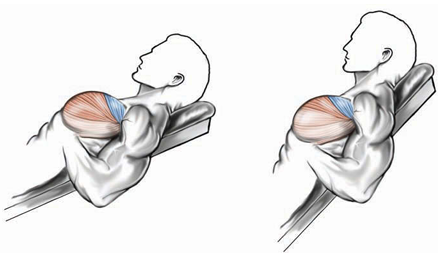
incline shifts
Grip: Dumbbell orientation affects hand position. The fl y exercise works best when the dumbbells are held with a neutral grip (palms facing together), but a pronated grip (palms facing forward) can also be used as a variation.
Range of motion: The lower the dumbbells descend, the greater the pectoral stretch. Too much stretch can cause injury to the muscle and the shoulder joint. It’s safer to terminate the descent when the dumbbells reach chest level.
VARIATION
Machine fly: Performing the machine fl y (described here) with the seat low and the handles at eye level will target the upper pectorals.

Low-Pulley Cable Fly
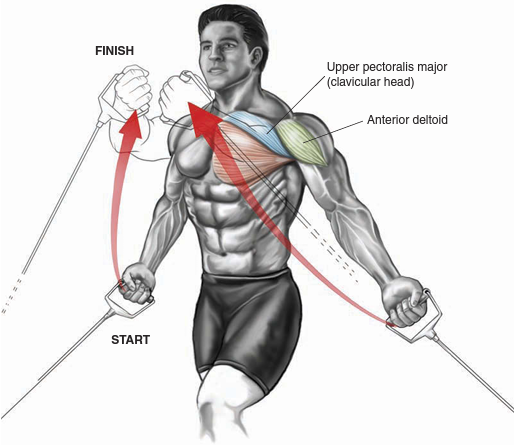
Low-pulley cable fly
Execution
1. In each hand, grasp a D-handle attached to the low pulleys, and stand upright.
2. Raise your hands up in a forward arc until the handles meet at head height.
3. Keeping your elbows stiff, lower the handles back to the start position.
Muscles Involved
Primary: Upper pectoralis major.
Secondary: Anterior deltoid.
Anatomic Focus
Trajectory: Standing forward so that the pulleys are slightly behind you affords a better trajectory to target the pectoral muscles.
VARIATION
Incline Cable Fly
Perform this exercise while lying on an incline exercise bench positioned centrally between the low pulleys, using similar technique to that of the incline dumbbell fly (described earlier).
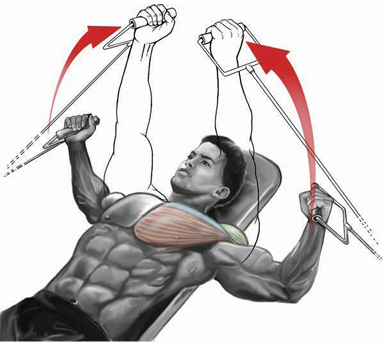
incline cable fly

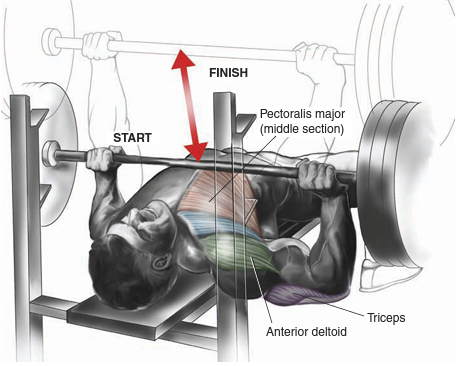
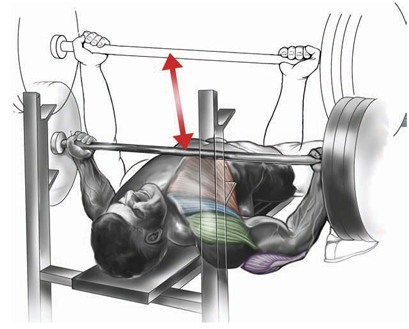
Barbell Bench Press

barbell bench press
Execution  
1. Pectoralis major (middle section) Anterior deltoid Triceps While lying on a fl at bench, take a shoulder-width overhand grip on the bar.
2. Lower the weight slowly down to touch the middle chest.
3. Push the bar straight up until your elbows lock out.
Muscles Involved
Primary: Pectoralis major.
Secondary: Anterior deltoid, triceps.
Anatomic Focus
Body position: Your torso should lie fl at with your shoulders and buttocks in contact with the bench. Plant your feet fi rmly on the fl oor for stability. If your lower back is arched (or your buttocks rise off the bench), the focus shifts to the lower pectorals. Raising your feet off the fl oor by bending your knees may help target the middle chest, but stability and balance are compromised when your feet are not in contact with the fl oor.
Hand spacing: The ideal hand spacing is shoulder width or slightly wider. A narrow (close) grip emphasizes the inner pectorals and also targets the triceps. Wider grips target the outer section of the muscle and minimize triceps contribution.
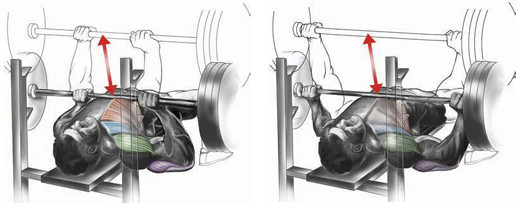
narrow wide grip
Trajectory: The bar should move vertically up and down from the middle chest (nipple area). Flare your elbows out as the bar is lowered to maximize pectoral isolation.
Range of motion: A shorter rep terminating the press just before lockout keeps tension on the pectorals and reduces the amount of triceps assistance.
Grip: An underhand (supinated) grip on the bar switches the focus to the triceps.
VARIATIONS
Machine Chest Press
Machines provide better stability and safety than the standard barbell press. Many machines offer a choice of grips. A neutral grip (thumbs up, palms facing together) isolates the pectorals better than a pronated grip (palms forward).
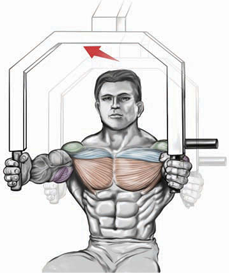
machine chest press
Additional variation:
Close-grip bench press: Perform the exercise with hands spaced approximately 6 inches (15 cm) apart. The narrow grip targets the inner pecs and works the triceps.

Dumbbell Bench Press
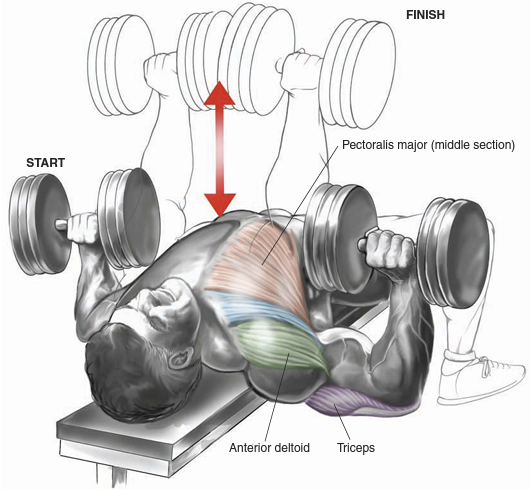
dumbbell bench press
Execution 
1.  While lying on a fl at bench, start with the dumbbells at chest level, palms facing forward.
2. Press dumbbells vertically upward until elbows lock out.
3. Lower dumbbells back down to middle chest. Muscles Involved Primary: Pectoralis major. Secondary: Anterior deltoid, triceps.
Anatomic Focus
Grip: Dumbbell orientation affects hand position. Holding the dumbbells with palms facing forward (pronated grip) provides more stretch as the weight is lowered to the start position. Holding the dumbbells with palms facing together (neutral grip) allows a better contraction in the lockout position.
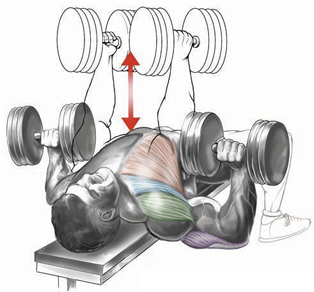
neutral grip at  lockout
Trajectory: Your torso should lie fl at on the bench, and the dumbbells should move vertically up and down from the middle chest (nipple area). To maximize pectoral isolation, fl are your elbows out wide during descent and touch the dumbbells together at lockout.
Range of motion: A shorter rep terminating the press just before lockout keeps tension on the pectorals and reduces triceps assistance. The lower the dumbbells descend, the more the chest muscle stretches. Lowering the dumbbells too far can cause shoulder injury; it is safer to terminate the descent when the dumbbells reach chest level.
VARIATION
Variable-grip dumbbell press: Hold the dumbbells with a pronated grip (palms forward) at the start; rotate the dumbbells as you press so that palms face together (neutral grip) at lockout.

Dumbbell Fly
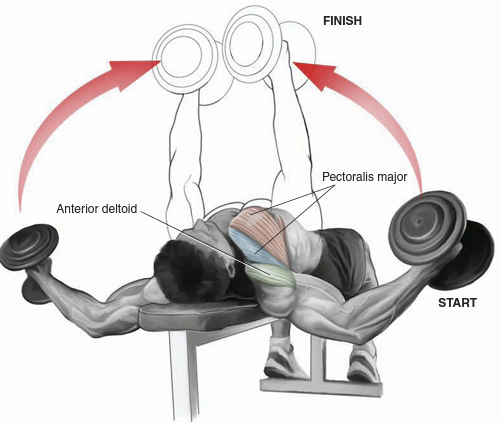
dumbbell fly
Execution
1. While lying on a fl at bench, begin with dumbbells directly above middle chest, palms facing together.
2. Lower the dumbbells out wide, bending elbows slightly as weight descends to chest level.
3. Raise dumbbells together in an upward arc back to the vertical position.
Muscles Involved
Primary: Pectoralis major.
Secondary: Anterior deltoid.
Anatomic Focus
Grip: Dumbbell orientation affects hand position. The fl y exercise works best when the dumbbells are held with a neutral grip (palms facing together), but a pronated grip (palms facing forward) can also be used for variation. Range of motion: The lower the dumbbells descend, the greater the pectoral stretch, but also the greater the chance of injury. It’s safer to terminate the descent when the dumbbells reach chest level.
VARIATION
Cable Fly
Perform this exercise with the exercise bench positioned centrally between two cable machines, and use D-handles attached to the low pulleys.
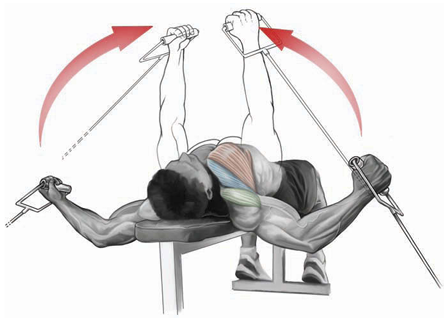
cable fly

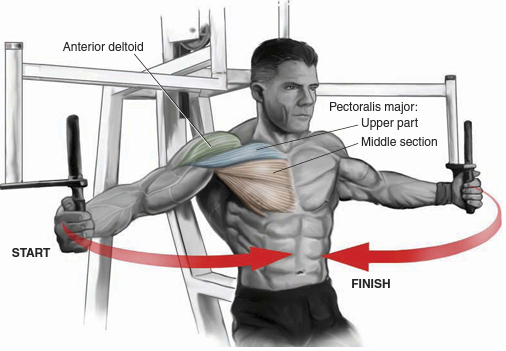
Machine Fly

machine fly
Execution
1. Grab the vertical handles, elbows slightly bent.
2. Squeeze the handles together until they touch in front of your chest.
3. Let your hands move back to the start position, keeping your elbows up.
Muscles Involved
Primary: Pectoralis major.
Secondary: Anterior deltoid.
Anatomic Focus
Grip: The fly exercise works best with a neutral grip (palms facing together), but a pronated grip (palms facing forward) can also be used for variation. Keep your elbows stiff and slightly bent throughout the movement.
Range of motion: The inner central portion of the pectoral muscle does most of the work as the handles are squeezed together. To emphasize the inner pecs, use a narrow range of motion focusing on the squeeze position. Perform partial reps, in which your hands move through a short 45-degree arc from the 12 o’clock (handles touching) position outward to 10 o’clock on the left and 2 o’clock on the right side. Keep your elbows straight to achieve maximum squeeze. The emphasis switches to the outer pecs when your hands move out wide. Do not allow the handles to pass behind the plane of your body, or you will enter the injury zone. It’s safer to terminate the stretch phase when your arms are in line with your chest.
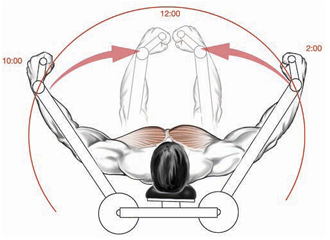
partial reps target the inner pectorals
Trajectory: Position the seat so the handles are level with your chest. To maximize pectoral isolation, keep your elbows high (shoulder level) during the movement.
Body position: When the seat is low and the handles are held high, the upper chest is emphasized. When the seat is high and the handles are held low, the lower chest is emphasized.
Resistance: Unlike dumbbell fl ys, where the resistance varies during the lift, the machine fl y affords a uniform resistance throughout the motion and is an excellent exercise for targeting the inner pecs.
VARIATIONS
Pec-Deck Fly
The pec-deck fly is a similar exercise using elbow pads instead of handles.
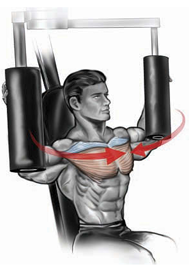
pec-deck fly
Additional variation:
One-arm machine fly: You can do this exercise using one arm at a time.

Decline Press
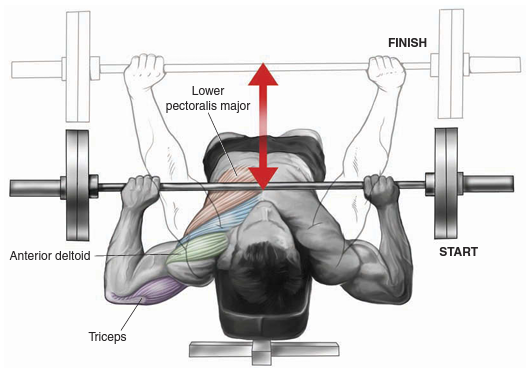
decline press
Execution
1. Lie on a decline bench and take a shoulder-width overhand grip on the bar.
2. Lower the weight slowly down to touch your lower chest.
3. Push the bar straight up until your elbows lock out.
Muscles Involved
Primary: Lower pectoralis major (sternal head).
Secondary: Triceps, anterior deltoid.
Anatomic Focus
Trajectory: The decline angle determines trajectory. As the bench is tilted head-down and the decline gets steeper, the focus shifts progressively lower down the pectoral muscle. The lower pectoral is best targeted at a decline of 20 to 40 degrees to the fl oor. Steeper declines shift the focus from the chest to the triceps. Flare your elbows out as the bar is lowered to maximize pectoral isolation.
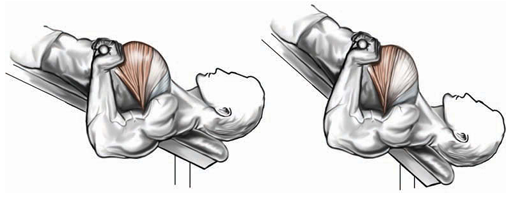
increased decline shifts focus to lower muscle
Hand spacing: The ideal hand spacing is shoulder width. Wider grips target the outer section of the muscle, afford a greater stretch, and minimize triceps contribution. A narrow (close) grip targets the inner pectorals and requires more work from the triceps.
Range of motion: A shorter rep terminating the press just before lockout keeps tension on the pectorals and reduces the amount of triceps assistance.
VARIATIONS
Decline Dumbbell Press
Performing the decline press using two dumbbells affords an increased range of motion as the weight is lowered. A barbell stops when it touches the chest, whereas dumbbells can be lowered farther for additional stretch at the bottom of the lift.
decline dumbbell press
Additional variation:
Machine decline press: Performing the decline press on a machine, such as the Smith machine, affords better stability and safety.

Decline Dumbbell Fly

decline dumbbell fly
Execution
1. While lying on a decline bench, begin with dumbbells directly above your chest, palms facing together.
2. Lower the dumbbells outward, bending elbows slightly as weight descends to chest level.
3. Raise dumbbells back up and together. Muscles Involved Primary: Lower pectoralis major (sternal head) Secondary: Anterior deltoid, triceps.
Anatomic Focus
Trajectory: The decline angle determines trajectory. As the bench is tilted head-down and the decline gets steeper, the focus shifts progressively lower down the pectoral muscle. The lower pectoral is best targeted at a decline of 20 to 40 degrees to the floor.
increased decline shifts focus to lower muscle
Grip: Dumbbell orientation affects hand position. The fl y exercise works best when the dumbbells are held with a neutral grip (palms facing together), but a pronated grip (palms facing forward) can also be used as a variation.
Range of motion: The lower the dumbbells descend, the greater the pectoral stretch, but also the greater the chance of injury. It’s safer to terminate the descent when the dumbbells reach chest level.
VARIATION
Variable-grip dumbbell fly: As the weight is lowered, hold the dumbbells with a pronated grip (palms forward) at the bottom, and then rotate the dumbbells during the lift so your palms face together (neutral grip) at the top.

Cable Crossover
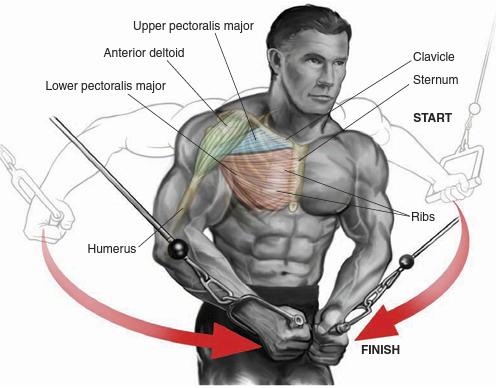
cable crossover
Execution
1. Standing upright, grasp the D-handles attached to the high pulleys of a cable machine.
2. Squeeze the handles down together until your hands touch in front of your waist; keep elbows slightly bent.
3. Slowly return to the start position with your hands at shoulder level.
Muscles Involved
Primary: Lower pectoralis major (sternal head).
Secondary: Anterior deltoid, triceps.
Anatomic Focus
Trajectory: Your torso should be upright or tilted forward slightly at the waist. The level at which your hands meet determines the focus on the muscle. A low trajectory, in which the handles meet in front of your hips or waist, targets the lowest fi bers of the pectoral muscle. A high trajectory, in which the handles meet at chest level, targets the midsection of the pecs.
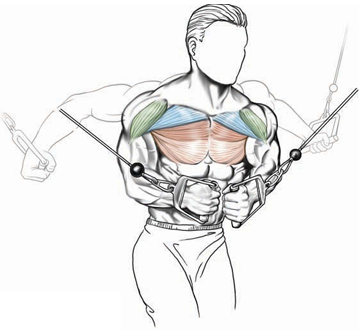
high trajectory targets midsection muscle
Range of motion: Crossing over your hands at the bottom increases the range of motion and targets the inner, central portion of the pectorals. Extending the start position by allowing your hands to pass above shoulder or head height affords a greater stretch but also places unnecessary stress on the shoulder joint.
VARIATION
Seated crossover: Newer machines allow you to perform this exercise while seated with a back support.

Chest Dip
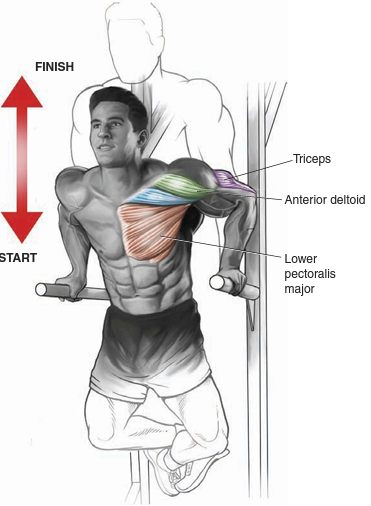
chest dip
Execution
1. Grab the parallel bars, supporting your body with elbows locked straight.
2. Bend your elbows, lowering your torso until upper arms are parallel to the f l oor.
3. Push yourself back up until your elbows lock out.
Muscles Involved
Primary: Lower pectoralis major (sternal head).
Secondary: Triceps, anterior deltoid.
Anatomic Focus
Trajectory: The position of your torso affects the focus of the exercise. A slight forward tilt is better for targeting the pectorals, and the more you bend forward the harder you work the pectorals. An upright posture shifts the focus to the triceps, and the more you straighten your torso the more you involve the triceps. Flare your elbows out as you descend to maximize pectoral isolation.
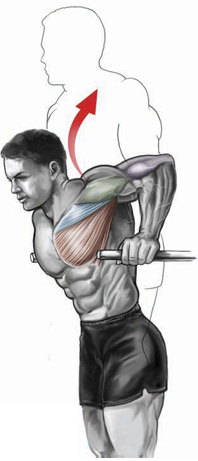
tilting forward targets the pectorals
Grip: A standard grip on the parallel bars with thumbs pointing forward works best when targeting the chest. A reverse grip with thumbs pointing backward shifts the focus to the triceps.
VARIATION
Machine dip: You can perform this exercise while seated on a machine. But since most dip machines restrict torso motion, they tend to target the triceps more than the chest.

THE SHOULDERS

Press

barbell shoulder press
Execution
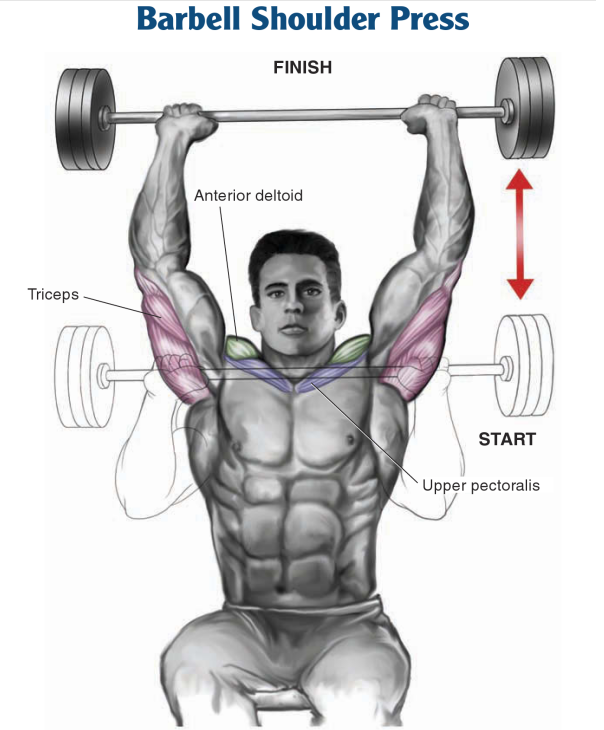
1. Seated on a bench, take a shoulder-width grip on the bar with your palms facing forward.
2. lower the weight slowly (in front) until it touches your upper chest.
3. Push vertically upward until your elbows lock out

Muscles Involved
PrImary: Anterior deltoid.
Secondary: lateral deltoid, triceps, trapezius, and upper pectoralis.
Anatomic Focus
Hand spacing: A shoulder-width grip is preferred to target the anterior deltoid. Wider grips on the bar minimize triceps contribution, but as the grip gets wider the risk of shoulder injury increases.
Range of motion: A shorter rep terminating the press Just before lockout keeps tension on the deltoid.
Positioning: Performing the exercise while seated upright Is a stricter version than standing and prevents cheating the weight upward using momentum generated by the legs .

VARIATIONS
machine shoulder press
Machine Shoulder Press
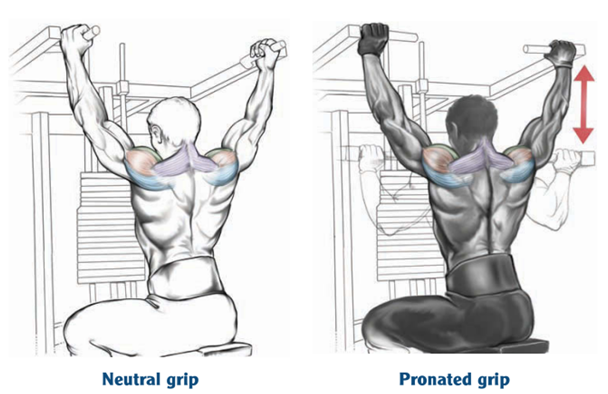
Machines provide better stability and safety and offer a choice of handgrlps. A neutral grip (palms facing together) targets the anterior deltoid better than a pronated grip (palms forward).
Additional variation:
Pronated grip
Behind-the-neck press: This version places the shoulder in more external rotation, and the risk of shoulder injury is greater when the weight is lifted behind the neck.

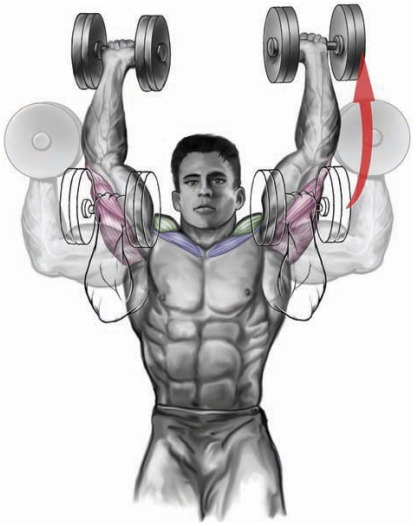
Dumbbell Shoulder Press


Execution
1. Seated on a bench, begin with the dumbbells at shoulder level, palms facing forward.
2. Press the dumbbells vertically upward until your elbows lock out.
3. Lower the dumbbells back down until they touch your shoulders.
Muscles Involved
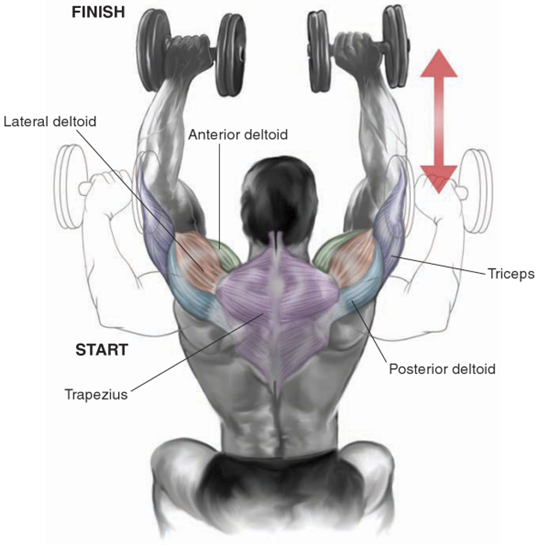
Primary: Anterior deltoid.
Secondary: Lateral deltoid, triceps, trapezius, upper pectoralis.
Anatomic Focus
 Grip: Changing the orientation of the dumbbells affects hand position (grip).
Pressing the dumbbells upward with palms facing forward (pronated grip) works both the anterior and the lateral heads of the deltoid. Pressing the dumbbells with palms facing together (neutral grip) makes the anterior deltoid work harder, minimizing lateral head involvement holding the dumbbells with palms facing backward (supinated grip) maximizes anterior deltoid effort.
Positioning: Performing the exercise while seated upright is a stricter version than standing and prevents cheating the dumbbells upward using.
VARIATIONS
variable-grip dumbbell press
Variable-Grip Dumbbell Press
This version uses three different hand positions during the repetition. Begin the exercise by holding the dumbbells with your palms facing back (supination). During the press, rotate the dumbbells so your palms face together (neutral grip) at the midpoint, finishing the upward press with your palms facing forward (pronated grip) at lockout.
Additional variation:
Alternating one-ann dumbbell press:Perform the exercise by pressing one dumbbell at a time, altemating right arm then left arm.

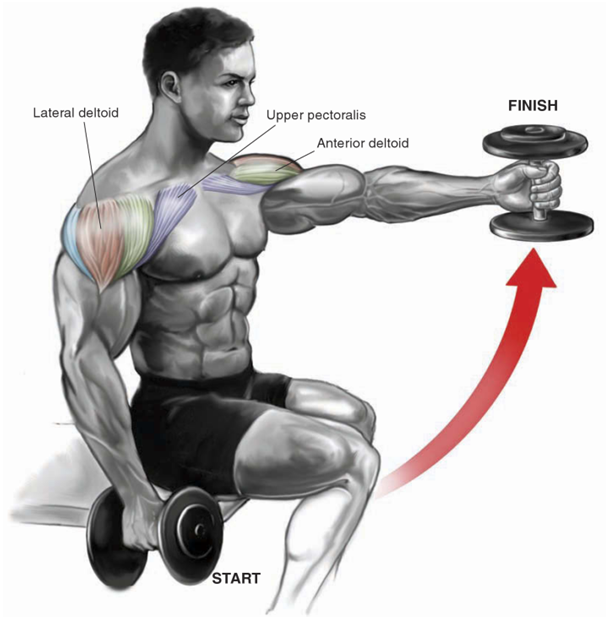
Dumbbell Front Raise

dumbbell front raise
Execution
1. Sitting upright on the edge of an exercise bench, hold a pair of dumbbells at arms’ length by your sides, thumbs pointing forward.
2. Lift one dumbbell out in front up toward shoulder level, keeping your elbow stiff.
3. Lower the weight back down to the start position, and repeat with the other dumbbell.

Muscles Involved
Primary: Anterior deltoid.
Secondary: Upper pectoralis, trapezius.

Anatomic Focus
Grip: A neutral grip (palm inward, thumb pointing forward) emphasizes the anterior deltoid. A pronated grip (palm down) allows the lateral deltoid to assist.
VARIATIONS
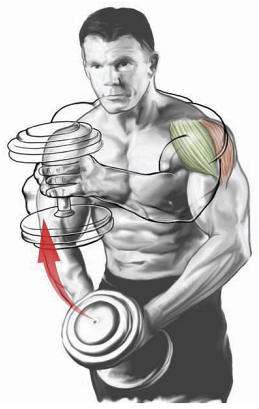
variable-grip dumbbell front raise
 Variable-Grip Dumbbell Front Raise
Begin with a neutral grip (thumb forward), then rotate the dumbbell through 90 degrees during the lift so that your grip is pronated (palm down) at the top.

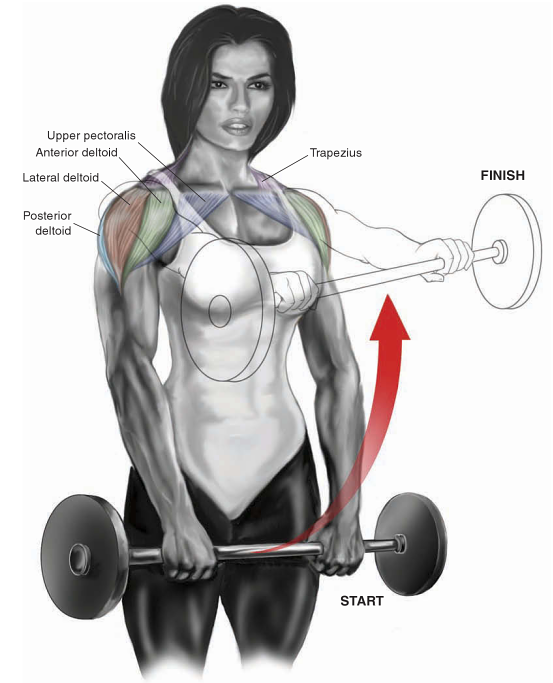
Barbell Front Raise

barbell front raise
Execution
1. Using an overhand shoulder-width griP. hold a barbell at arms’ length in front of your thighs.
2. Raise the barbell forward and upward to eye level. keeping your elbows
3. Lower the barbell back down to your thighs.

Muscles Involved
Primary: Anterior deltoid.
Secondary: Lateral deltoid. trapezius, upper pectoralis.

Anatomic Focus
Hand spadns: Narrow hand spadng emphasizes the anterior deltoid, whereas a wider grip requires lateral deltoid assistance.
VARIATIONS
Single Dumbbell Front Raise
Grab a dumbbell with both hands, Interlocking your fingers around the handle. The neutral grip (thumbs pointing forward) and narrow hand spacing target the anterior deltoid, minimizing Involvement of the lateral deltoid.

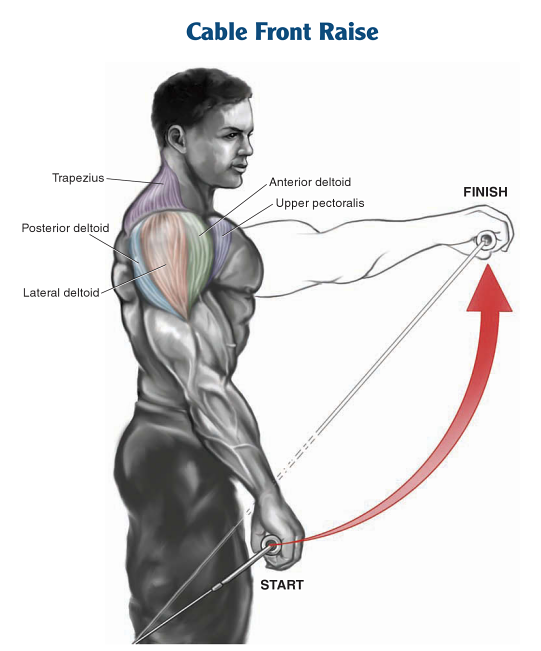
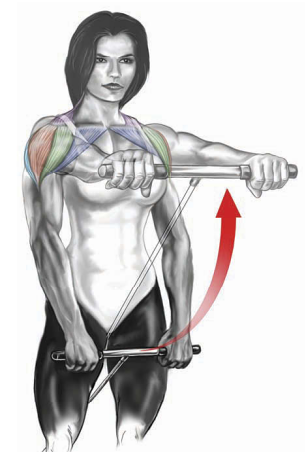
Cable Front Raise

Cable Front Raise
Execution
1. With one hand, grab the D-handle attached to a low pulley, using a pronated grip (palm down).
2. Facing away from the weight stack, raise the handle In an upward arc to shoulder level, keeping the elbow stiff.
3. Lower the handle back down to waist level.

Muscles Involved
Primary: Anterior deltoid.
Secondary: Lateral deltoid, trapezius, upper pectoralis.

Anatomic Focus
Grip: The pronated overhand grip works the anterior and lateral heads of the
VARIATIONS
Short Bar Attachment
Facing away from the machine with the cable running between your legs, grab the bar with both hands, using a shoulderwidth overhand grip.
Additional variation:
Rope attachment: Facing away from the machine with the cable running between your legs, grab the rope ends with both hands, thumbs pointing upward.

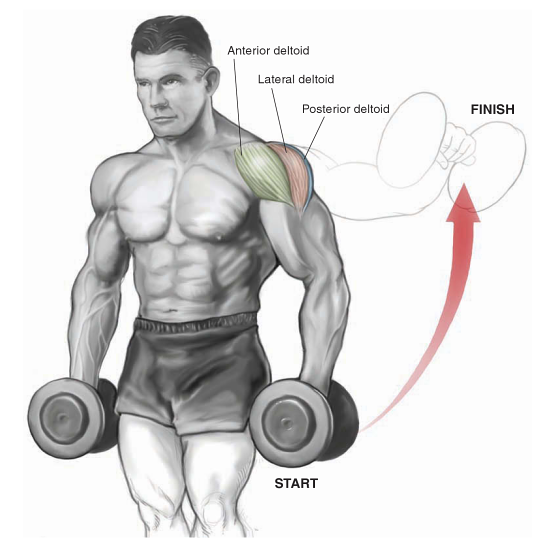
Dumbbell Lateral Raise

Dumbbell Lateral Raise
Execution
1. While standing upright, hold dumbbells at arms’ length.
2. Raise arms out to the side in an arc until dumbbells reach shoulder level.
3. Lower dumbbells back down to hips.

Muscles Involved
Primary: Lateral deltoid.
Secondary: Anterior deltoid, posterior deltoid, trapezius, supraspinatus.
Anatomic Focus
Range of motion: The lateral deltoid performs most of the work as the dumbbells are raised up to shoulder level. The trapezius takes over if the dumbbells are raised higher, so terminating the upward phase at shoulder level keeps tension on the deltoid.
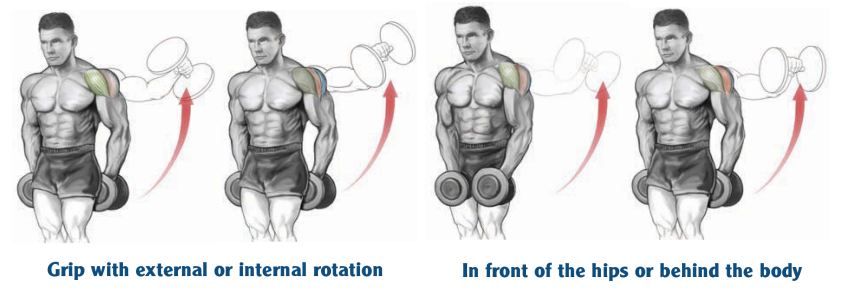
Grip: Effort from the lateral deltoid is maximized when the dumbbells are held parallel to the floor. Tilting the dumbbells with thumbs up externally rotates the shoulder and makes the anterior deltoid contribute to the motion, whereas tilting the dumbbells with thumbs down internally rotates the shoulder, allowing the posterior deltoid to assist.
Trajectory: Lifting the dumbbells directly out tothe side hits the lateral deltoid. Raising the dumbbells from in front of the hips with a forward arc makes the anterior deltoid assist. If the arc of motion occurs behind the plane of the body, then the posterior deltoid contributes to the lift.
Resistance: Because of the effect of gravity on the dumbbells, resistance Is lower at the beginning of the movement and gradually Increases to a maximum as the dumbbells are raised to shoulder level.
Grip with external or internal rotation in front of the hips or behind the body
VARIATIONS
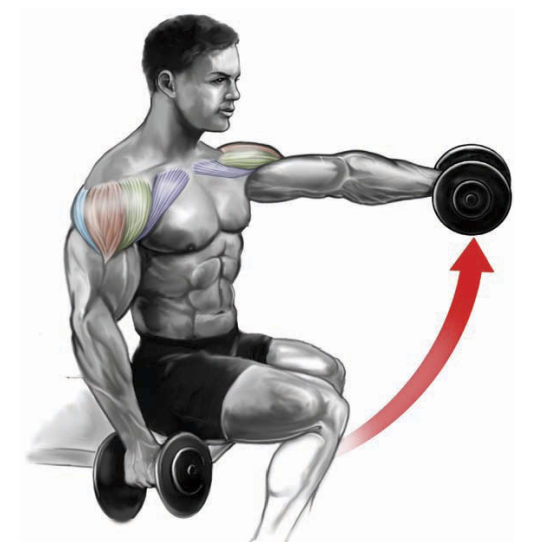
Seated dumbbell lateral raise: Performing the dumbbell lateral raise seated on a flat exercise bench Is a stricter version of the standing dumbbell lateral raise, minimizing the use of momentum to swing the dumbbells upward.
One-ann dumbbell lateral raise: You can perform this exercise using one arm at a time, stabilizing your torso with your free hand.

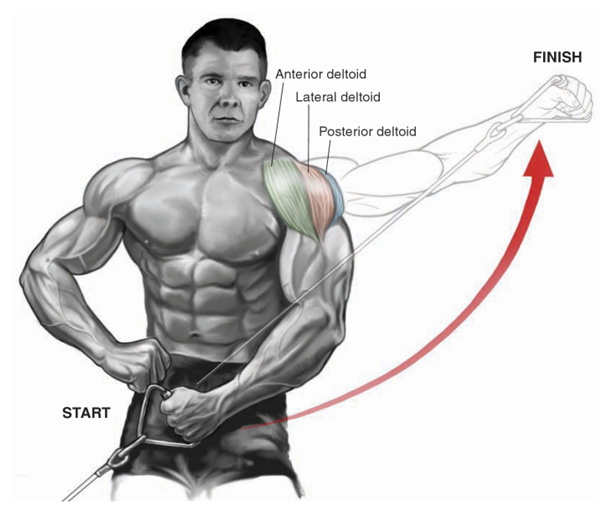
Cable Lateral Raise

Cable Lateral Raise
Execution
1. With one hand, grasp the D-handle attached to a low pulley.
2. Raise hand outward in a wide arc up to shoulder level, keeping the elbow
3. Lower the handle back down to waist level.

Muscles Involved
Primary: Lateral deltoid.
Secondary: Anterior deltoid, posterior deltoid, trapezius, supraspinatus.

Anatomic Focus
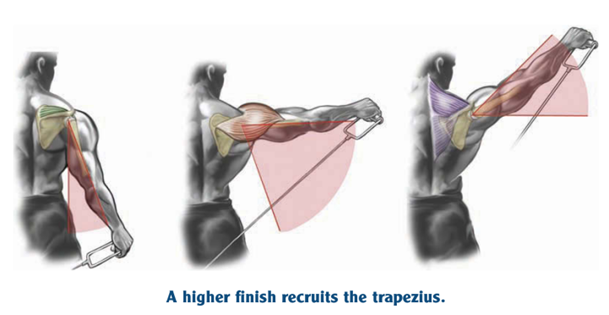
Range of motion: Terminating the upward phase at shoulder height keeps tension on the lateral deltoid. If the handle is raised higher, the trapezius takes over the work. The supraspinatus assists the lateral deltoid during the first 30 degrees of the movement. Starting the repetition with your hand In front of the opposite thigh can increase the range of motion by extending the early phase of the movement.
higher finish recruits the trapezius
Trajectory: The lateral deltoid is targeted best when the hand Is raised directly out to the side. Performing the raise in front of the plane of your body activates the anterior deltoid, whereas raising your hand from the rear activates the posterior deltoid.
Resistance: Unlike dumbbell lateral raises, where the resistance varies during the lift, the cable pulley provides uniform resistance throughout the

Machine Lateral Raise

Machine Lateral Raise
Execution
1. Sit on the machine with your elbows against the pads, and grasp the
2. Raise your elbows to shoulder level, upper arms parallel to the floor.
3. Lower elbows back down to your sides.

Muscles Involved
Primary: Lateral deltoid.
Secondary: Anterior deltoid, posterior deltoid, trapezius, supraspinatus.
Anatomic Focus
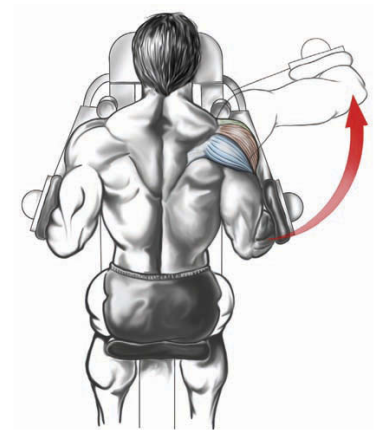
Range of motion: Machine raises provide a uniform resistance throughout the movement. The supraspinatus assists at the start, and the trapezius assists if the elbows are raised above shoulder level.
Grip: A pronated grip (palms down) internally rotates the shoulder and targets the lateral deltoid. A neutral grip (palms fadng in) or supinated grip (palms up) externally rotates the shoulder and Increases the contribution of the anterior deltoid. Changes in shoulder rotation are made easier by gripping the elbow pads andnot holding onto the machine’s handles.
Trajectory: Altering the trajectory of the 11ft changes the relative focus on the deltoid. Raising your elbows directly out to the sides hits the lateral deltoid. Performing the raise with your elbows positioned forward on the pads makes the anterior deltoid assist.
VARIATIONS
One-Arm Machine Lateral Raise
You can perform this exercise using one arm at a time to improve focus and isolation. Some machines are designed so that you face inward, stabilizing your torso against a chest pad.
One-Arm Machine Lateral Raise

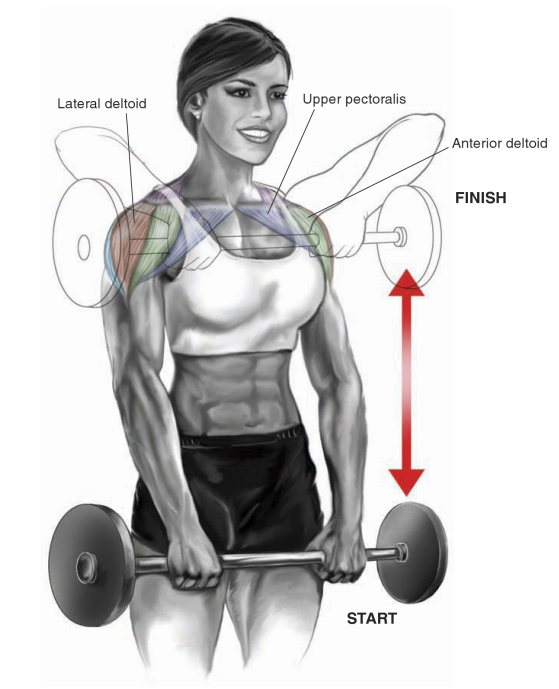
Barbell Upright Row

Barbell Upright Row
Execution
1. Hold a barbell at arms’ length using an overhand shoulder-width grip.
2. Pull the bar vertically upward, raising the elbows to shoulder height.
3. Lower the bar slowly down to the arms’ extended position.

Muscles Involved
Primary: Lateral deltoid, trapezius.
Secondary: Anterior deltoid, supraspinatus, Infraspinatus, teres minor.

Anatomic Focus
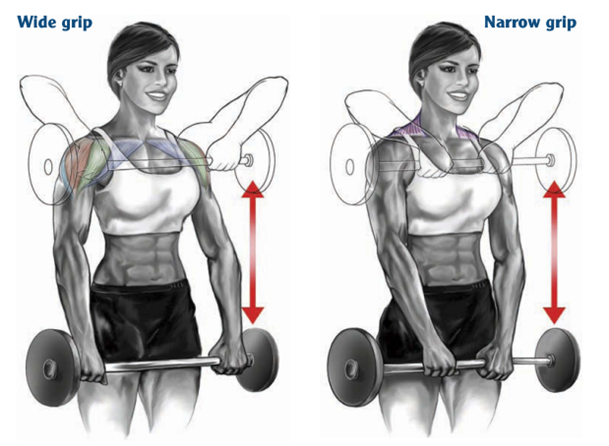
Hand spacing: Taking a wider grip on the bar helps target the deltoid, whereas a narrower grip emphasizes the trapezius.
Barbell Upright Row hand spacing
Trajectory: Lifting the barbell close to the body targets the lateral deltoid,whereas raiSing the bar through a forward arc away from the body requires assistance from the anterior deltoid.
Range of motion: If the elbows are raised above shoulder level, the trapezius takes over the work.

VARIATIONS
Cable upright row: Using a straight bar attached to the low pulley of a cable machine provides steady resistance throughout the movement.
Machine upright row: Using a Smith machine provides a single plane of vertical motion that may help focus your effort.

Bent-Over Dumbbell Raise

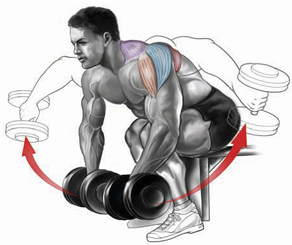
bent-over dumbbell raise
Execution
1. Holding two dumbbells at arms’ length, bend forward at the waist, keeping your back straight and head up.
2. With palms facing together, raise dumbbells upward to ear level, keeping elbows slightly bent.
3. Lower dumbbells back down to start position.

Muscles Involved
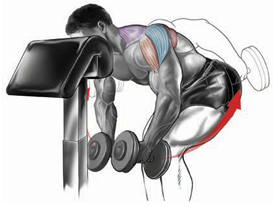
Primary: Posterior deltoid.
Secondary: Lateral deltoid, trapezius, rhomboids, infraspinatus, teres minor, teres major.
Anatomic Focus

Grip: The way you hold the dumbbells influences the degree of rotation at the shoulder joint. Holding the dumbbells using a neutral grip (with thumbs pointing forward) allows the lateral deltoid to work in the exercise. A pronated grip on the dumbbells (with thumbs pointing inward) targets the posterior deltoid because the shoulder is rotated internally and the action of the lateral deltoid is reduced.
Resistance: Because of the effect of gravity on the dumbbells, the resistance is lower at the beginning of the movement and gradually increases to a maximum as the dumbbel ls are raised.
Trajectory: Altering the trajectory of the lift changes the relative focus on the deltoid. With your torso f lat and parallel to the floor, emphasis is placed on the posterior deltoid. If your torso is inclined with your chest upright, the lateral deltoid contributes to the movement.

VARIATIONS
 Head-Supported Dumbbell Raise
head-supported dumbbell raise
You can do this exercise with your forehead supported on the uppermost end of an incline exercise bench. Stand behind and in line with the bench, bend forward at the waist until your head touches the top of the backrest (which should be set at an appropriate height for your torso to be almost parallel to the floor). Supporting your head restricts movement in the spine and prevents swinging the dumbbells upward with momentum.
Seated Bent-Over
seated bent-over dumbbell raise
Dumbbell Raise
Sit on the end of an exercise bench while bent forward at the waist with your chest resting on the thighs. Note the pronated grip on the dumbbells (thumbs pointing inward), which improves isolation of the rear deltoid.

Bent-Over Cable Raise

bent-over cable raise
Execution
1. Grab the handles attached to two low pulleys Oef

THE ARMS


Barlbell Curl

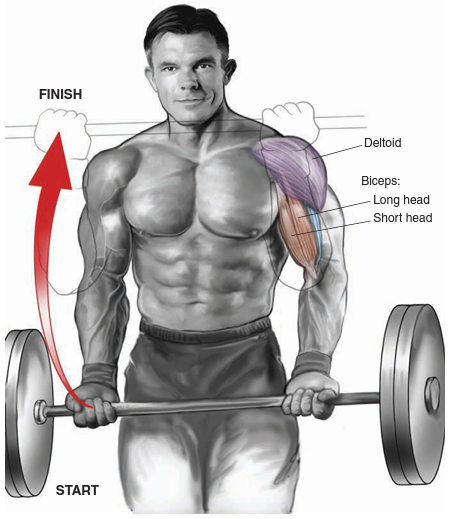
barbell curl
Execution
1. Hold a barbell at arms’ length, using a shoulder-width underhand grip.
2. Curl the bar up to shoulder level by bending your elbows.
3. Lower the bar back down to the arms’ extended position.
Muscles Involved
Primary: Biceps.
Secondary: Brachialis, brachioradialis, anterior deltoid, forearm.
Anatomic Focus
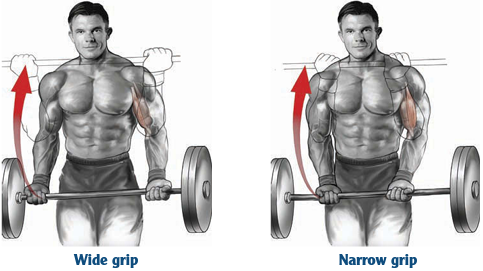
Hand spacing: A wide grip focuses effort on the inner biceps (short head), whereas a narrow grip works the outer biceps (long head).
wide narrow grip
Grip: With a straight bar, the underhand grip is fixed in supination (palms upward). Grip may be adjusted using an EZ bar (see Variation section).
Trajectory: The bar should move up and down in an arc close to the body. To isolate the biceps, motion should occur at the elbow and not the shoulder.
Range of motion: Stopping a few degrees short of full elbow extension keeps tension on the biceps as the barbell is lowered.
Body position: Stand upright with the spine straight. Tilting the torso is often used as a method of cheating the bar upward with momentum. Leaning slightly forward makes the initial phase of the curl easier. Leaning slightly backward helps complete the final phase of the repetition.


VARIATIONS
 EZ Bar CurI
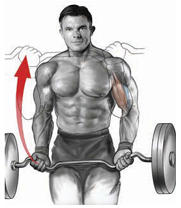
ez bar curl
Performing the curl with an EZ bar changes the grip. The hands switch from the fully supinated (palms up) grip to a less supinated, nearly neutral grip (palms facing in). This hand position emphasizes the outer (long) head of the biceps and the brachial is, and it is less strenuous on the wrist joint.


Dumbbell Curl

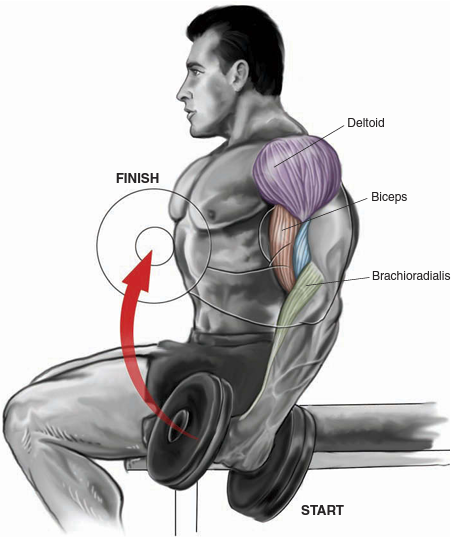
dumbbell curl
Execution
1. Hold a pair of dumbbells at arms’ length by your sides, thumbs pointing
2. One arm at a time, curl the dumbbell up toward your shoulder, rotating your hand so the palm faces upward.
3. Lower the dumbbell back down, and repeat with the opposite arm.

Muscles Involved
Primary: Biceps.
Secondary: Brachialis, brachioradialis, anterior deltoid, forearm .

Anatomic Focus
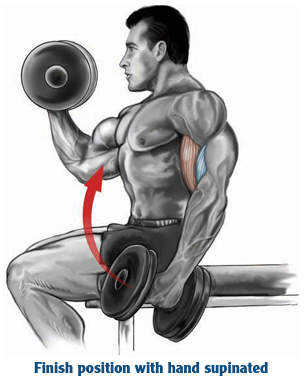
Grip: The dumbell curl works the biceps in two ways: elbow flexion and forearm supination . Hence, to maximize biceps contraction, supinate the hand (palm uppermost) as he dumbbell is raised.
finish position with hand supinated
Hand spacing: Instead of grasping the dumbbell in the middle of the bar, slide your palm over so your thumb rests against the inside of the plate. This grip change increases the load on the biceps during supination, activating more muscle fibers when the dumbbell is rotated.
Trajectory: Position your torso upright with the spine straight. Tilting the torso is often used as a method of cheating the weight upward with momentum. Leaning slightly forward makes the initial phase of the curl easier. Leaning slightly backward helps complete the final phase of the repetition.
Range of motion: Use a full range of motion at the elbow.

VARIATIONS
Standing dumbbell curl: This exercise can be performed in a standing position, but this requires muscular effort in the legs. The seated version of the exercise (illustrated) affords better focus.
Incline dumbbell curl: When performed while seated on an incline bench, effort is focused on the lower portion of the biceps, near the elbow.

Concentration Curl

concentration curl
Execution
1. Sit on the edge of a bench. Hold a dumbbell at arm’s length, supporting your arm against the inside of your thigh.
2. Curl the dumbbell up toward your shoulder by bending at the elbow.
3. lower the dumbbell back down to the start position.

Muscles Involved
Primary: Biceps.
Secondary: Brachialis, brachioradialis, forearm muscles.

Anatomic Focus
vertical arm position tergeting upper biceps
Grip: An underhand grip places the hand in supination and thereby maximizes biceps contraction.
Trajectory: The position of the upper arm (relative to the floor) changes the focus of effort. When the arm is vertical (shoulder directly above the elbow), resistance increases as the dumbbell is raised, and effort is focused on the upper biceps (peak). With the arm at an inclined angle (elbow in front of the shoulder), resistance is maximal at the start, so effort is targeted on the lower section of the biceps at the elbow.
Range of motion: Resting the upper arm against the thigh prevents movement at the shoulder and is an excellent way to isolate the biceps.
Body position: The torso should remain motionless, supported by your free hand on the opposite thigh.


VARIATIONS
One-ann cable curl: You can also perform a concentration curl while using a D-handle attached to the cable of a low pulley.


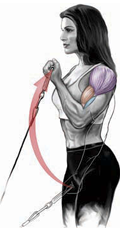
Cable Curl

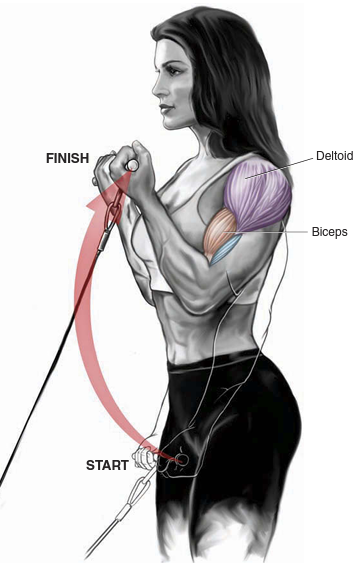
cable curl
 Execution
1. Grasp the short bar attached to a low pulley, using an underhand grip with arms straight.
2. Curl the bar up toward your shoulders by bending at the elbows.
3. Lower the weight down to the arms’ extended position.

Muscles Involved
Primary:Biceps.
Secondary: Brachialis, brachioradialis, anterior deltoid, forearm.


Anatomic Focus
Hand spacing:A wider-than -shoulcler-width grip focuses effort on the inner biceps (short head), whereas a narrow grip works the outer biceps (long head).
Grip: With a straight bar, the underhand grip is fixed in supination (palms upward). Using an EZ bar attachment, grip switches from the fully supinated position to a less supinated, nearly neutral grip (palms fadng in). This hand position is less strenuous on the wrist joint and tends to emphasize the outer (long) head of the biceps and the brachialis musde.
Body position: Stand upright with the spine straight.
Range of motion: Fixing the elbows against your sides prevents movement at the shoulder and is an excellent way to isolate the biceps.
Resistance: Unlike barbell or dumbbell curls where the resistance varies during the lift, the cable pulley provides a uniform resistance throughout the


VARIATIONS
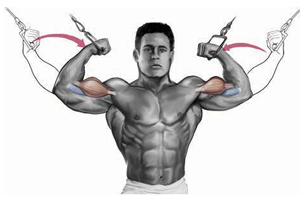
 High-Pulley Curl
high-pulley curl
Grasp the D-handles attached to two high pulleys using an underhand grip, and stand midway between the pulleys. With your arms held at shoulder level, curl the handles toward your head. This version emphasizes the long head of the biceps and works the biceps peak.

One-Arm Cable Curl
one-arm cable row
Perform the exercise one arm at a time using a D-handle attached to the low pulley.


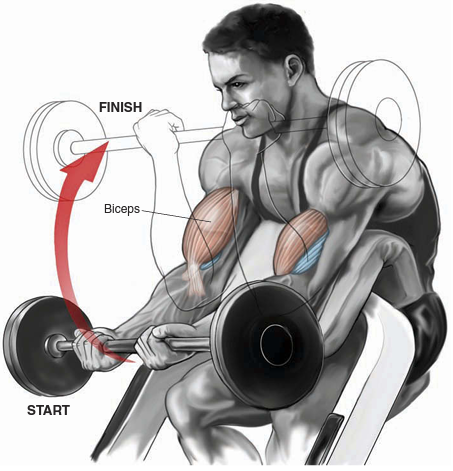
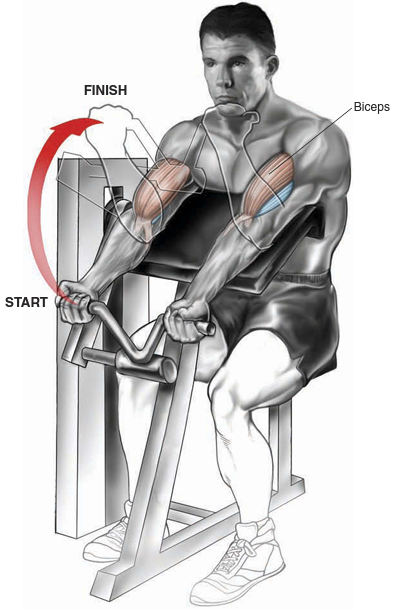
Preacher CurI

preacher curl
Execution
  1. Sit with your upper arms resting on the preacher bench, and take a shoulder-width underhand grip on the bar with arms out straight.
2. Curl the bar up toward your shoulders.
3. Lower the weight back down to the arms’ extended position.

Muscles Involved
Primary:Biceps.
Secondary:Brachialis, brachioradialis, forearm.

Anatomic Focus
Hand spacing: A wide grip focuses effort on the inner biceps (short head), whereas a narrow grip works the outer biceps (long head).
Grip: With a straight bar, the underhand grip is fixed in supination (palms upward) You may adjust the grip using an EZ bar.
Trajectory: With the upper arms supported at an incIined angle, resistanc is maximal at the start, so effort i targeted on the lower section of the biceps near the eIbow
Range of motion: Resting the upper arms on the bench prevents movement at the shoulders and the thereby helps iso late the biceps, Stopping a few degrees short of full elbow extension keeps tension on the biceps as the barbell is lowered.
Body position: Adjust the seat height so that your armpit is snug against the upper edge of the pad.

VARIATIONS
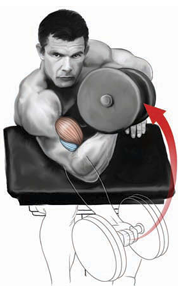
Dumbbell Preacher Curl
dumbbell preacher curl
Performing the exercise one arm at a time with a dumbbell improves focus and isolation,

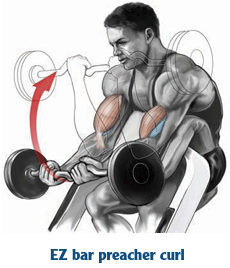
EZ Bar Preacher Curl
EZ bar preacher curl
Using an EZ bar, the grip switches from the fully supinated (palms up) position to a less supinated, nearly neutral grip (palms facing in), This hand position tends to focus effort on the outer (long) head of the biceps and the brachialis muscle, and it is less strenuous on the wrist joint.


Machine Curl

machine curl
 Execution
1. Grasp the bar using a shoulder-width underhand grip. with your elbows resting on the pad and arms out straight.
2. Curl the bar toward your shoulders by bending at the elbow.
3. Return the bar to the arms’ extended position.

Muscles Involved
Primary: Biceps.
Secondary: Brachialis, brachioradialis, forearm.

Anatomic Focus
Hand spacing: A wide grip focuses effort on the inner biceps (short head), whereas a narrow grip works the outer biceps (long head).
Grip: An angled handlebar is less strenuous on the wrist joint
Trajectory: Depending on the design of the machine, an indine arm pad focuses effort on the lower portion of the biceps, whereas a flat horizontal pad emphasizes the middle-biceps peak.
Range of motion: Effort focuses on the lower biceps during the initial phase of the curi, then switches to the middle biceps (peak) as the weight is raised.
Resistance: Unlike barbell or dumbbell curls, where the resistance varies during the lift, the machine provides a uniform resistance throughout the

VARIATIONS
Flat-Pad Machine Curl
flat-pad machine curl
In contrast to an indine arm pad, the trajectory of a flat horizontal arm pad focuses on the biceps peak.

Additional variation:
One-arm machine curl:
Performing the exercise one arm at a time improves focus and isolation.


Triceps Pushdown

triceps pushdown
Execution
1. Take a shoulder-width overhand grip on a short bar attached to the high
2. Begin with the bar at chest level, elbows bent a little more than 90 degrees.
3. Keeping your upper arms stiff, push the bar down until your elbows lock out

Muscles Involved
Primary: Triceps.
Secondary: Deltoid, forearm.

Anatomic Focus
Hand spacing: A wide grip focuses effort on the inner triceps (long head), whereas a narrow grip focuses on the outer triceps (lateral head).
Grip: Using the straight bar, a pronated grip (palms down) emphasizes the outer lateral head of the triceps, whereas a supinated grip (palms up) focuses effort on the inner long head. An angled V-shaped bar switches the hands into a neutral grip (thumbs up) that targets all three heads of the triceps equally.
Trajectory: With the upper arms perpendicular to the floor. the outer triceps (lateral head) contributes to the movement. If you perform the exercise with your arms raised parallel to the floor. you focus effort on the inner triceps (long head).
Range of motion: Fixing the upper arms against your sides prevents movement at the shoulder and is an excellent way to isolate the triceps. Motion should occur through the elbow only.
Resistance: Unlike barbell or dumbbell exercises. where the resistance varies during the lift. the cable provides a uniform resistance throughout the movement.
Body position: Standing upright with the spine straight is the standard position. Leaning the torso slightly forward at the waist provides better stability when using heavier weights.

VARIATIONS
Rope Pushdown
rope pushdown
The rope attachment affords a forcible pronation at the wrist. which targets the outer lateral head of the triceps.
Reverse-Grip Pushdown
reverse-grip pushdown
A reverse underhand grip focuses effort on the inner long head of the triceps.
Additional variation:
One-arm pushdown: Performing the exercise one arm at a time with the D-handle, using an overhand or underhand grip. focuses effort and improves isolation.

Dip

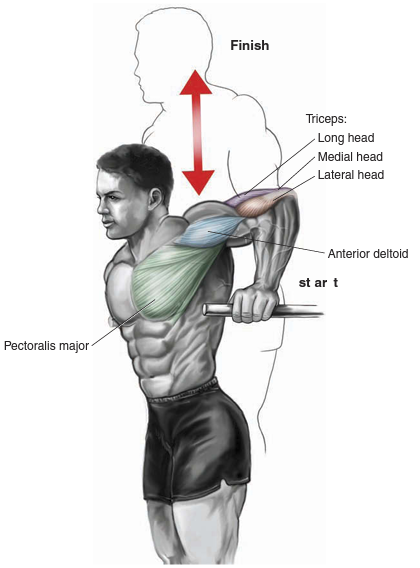
dip
Execution
1. Grasp the parallel bars and lift yourself up until your arms are fully
2. Bend your elbows and slowly lower your body until your upper arms are parallel to the floor; keep your torso upright.
3. Push yourself back up, straightening your arms until the elbows lock out.

Muscles Involved
PrImary: Triceps.
Secondary: Chest, anterior deltoid, forearm.

 Anatomic Focus
Hand spacing: When the apparatus allows, a wide grip focuses effort on the inner triceps (long head), whereas a narrow grip focuses on the outer triceps (lateral head).
Grip: The standard grip, palms facing together with thumbs forward, hits all three heads of the triceps, with an emphasis on the inner long head. Reversing the grip so that the palms face outward with thumbs facing back switches most of the effort to the outer triceps (long head).
reverse grip
Trajectory: Keeping the elbows close to your sides helps isolate the triceps. Flaring the elbows out wide allows the chest muscles to assist.
Range of motion: To isolate the triceps, movement should occur primarily at the elbow, so keep motion at the shoulder to a minimum.
Body position: To focus effort on the triceps, keep your body upright. Leaning forward makes the chest muscles do more work.
Resistance: Resistance is provided by your body weight and is not easily adjusted. You can add resistance by attaching a weighted belt around your hips.

VARIATION
Machine Dip
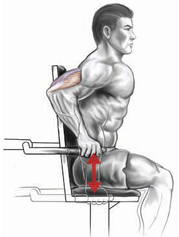
machine dip
Performing the exercise while seated in the triceps pushdown (dip) machine, where the resistance is adjustable, makes it easier to focus your effort on the triceps. All the tips mentioned previously for the parallelbar dip also apply to the machine variation.

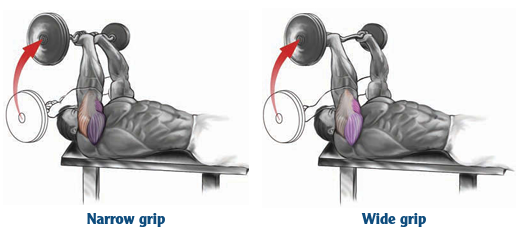
 Lying Triceps Extension

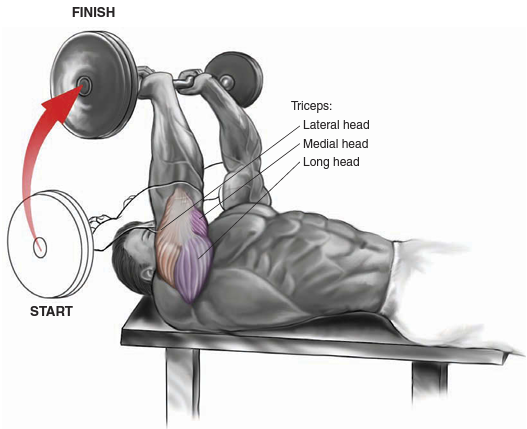
lying triceps extension
 Execution
1. Lying on a flat bench, hold a barbell at arms’ length above your chest with a narrow overhand grip, hands approximately 6 inches (15 em) apart.
2. Bend at the elbows and lower the bar down to touch your forehead.
3. Push the bar upward until your elbows lock out.

Muscles Involved
Primary: Triceps.
Secondary: Chest, deltoid, forearm.

Anatomic Focus
Hand spacing: A wide grip emphasizes the inner triceps (long head), whereas a narrow grip targets the outer triceps (lateral head). Keep the elbows close, and do not allow them to flare outward to the sides.
wide narrow grip lying triceps extension
Grip: Using a straight bar, you may perform this exercise with an overhand (pronated) grip or an underhand (supinated) grip. Using an EZ bar or dumbbells (see Variations section) requires a neutral grip. An overhand grip works the inner (long) head, an underhand grip emphasizes the outer (lateral) head, and a neutral grip works all three heads of the triceps.
Trajectory: The vertical position of the arm stretches the inner (long) head of the triceps, so this exercise targets this section of the muscle. Lowering the bar beyond the forehead toward the bench generates a greater stretch in the long head, favoring its contraction during the movement.
Body position: Keep your elbows pointing up and upper arms vertical. Do not lower the bar toward your face or chin, because this causes the elbows to drop and allows the deltoid and pectoral muscles to assist in the
Range of motion: To isolate the triceps, motion should occur only at the elbow, not at the shoulder.

VARIATIONS
Dumbbell lying triceps extension: Perform the exercise with a dumbbell in each hand; thumbs should pOint toward your face (neutral grip).
Reverse grip: You can also perform the exercise while using a reverse (supinated) grip on the bar to emphasize the outer (lateral) head of the triceps.

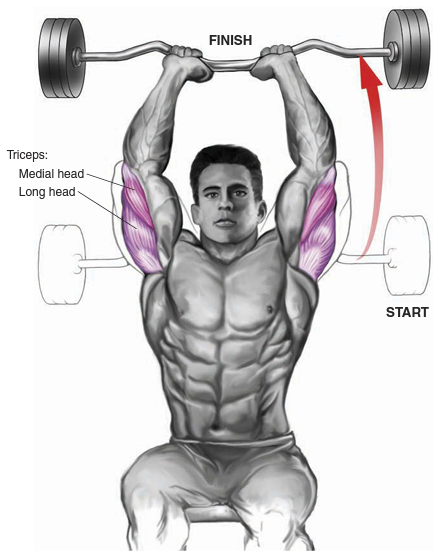
Seated Triceps Press

seated triceps press
Execution
1. Sit upright while holding a barbell in both hands at arms’ length above your head use a narrow overhand grip.
2. Bend at the elbows and lower the bar down behind your head.
3. Push the bar upward until your elbows lock out.

Muscles Involved
Primary: Triceps.
Secondary: Deltoid, forearm.

Anatomic Focus
Hand spacing:A wide grip emphasizes the inner triceps (long head), whereas a narrow grip targets the outer triceps (lateral head). Keep the elbows close together, and do not allow them to flare outward.
Grip: Using a straight bar, this exercise requires an overhand (pronated) grip. Using an EZ bar or a dumbbell (see the Variations section) requires a neutral grip. An overhand grip works the inner (long) head, whereas a neutral grip works all three heads of the triceps.
Trajectory: The vertical position of the arm stretches the inner long head of the triceps, so this exercise preferentially targets this section of the muscle.
Range of motion: To isolate the triceps, motion should occur at the elbow.
Safety: The triceps extension exercise poses two safety concerns. First, it places excessive stretch on the triceps tendon; second, it places the shoulder joint in a vulnerable position for injury. Therefore, it is not the best exercise choice for people who have elbow or shoulder pain.

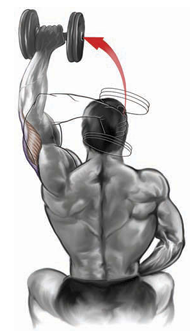
Single-Dumbbell Seated Triceps Press
You may perform this exercise one arm at a time while holding a dumbbell with the palm facing forward to emphasize the outer (lateral) head of the triceps.
 single- dumbbell seated triceps press
Additional variation:
EZ bar triceps press: Performing this movement with an EZ bar offers a variety of grip choices.

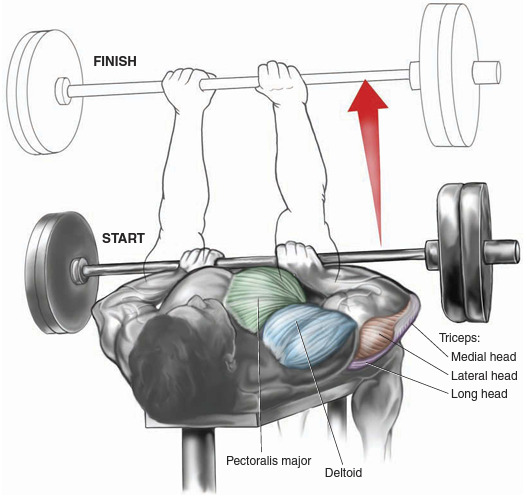
Close-Grip Bench Press

close- grip bench press
 Execution
1. Take a narrow (6-inch, or 15-centimeter) overhand grip on the bar.
2. Lower the weight down slowly to touch the middle chest.
3. Push the bar straight up until your elbows lock out.

Muscles Involved
Primary: Triceps, pectoralis major.
Secondary: Anterior deltoid.

 Anatomic Focus
Hand spacing:To target the trice ps, hand spacing should be narrower than shoulder width.
Grip: An underhand (supinated) grip on the bar also targets the triceps, but this grip requires the hands to be spaced wide apart (see Variation section).
Trajectory: Keep your elbows close to your sides to emphasize the triceps, not the chest.
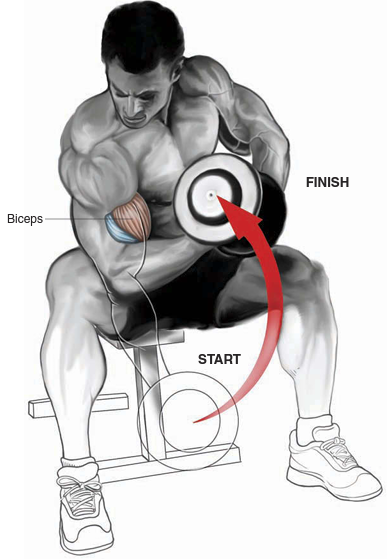
Range of motion: A full range of motion (achieving full lockout) is required for maximizing triceps effort.
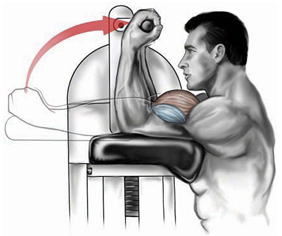
VARIATIONS
Reverse Grip Bench Press
reverse grip bench press
Performing the bench press using an underhand grip (palms facing up) with hands spaced more than shoulder-width apart also targets the triceps.
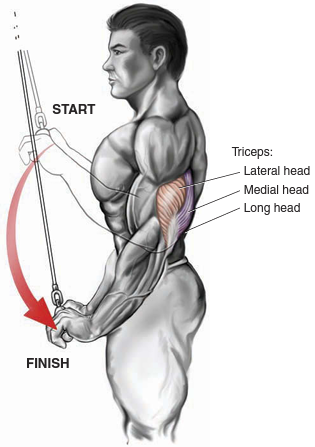
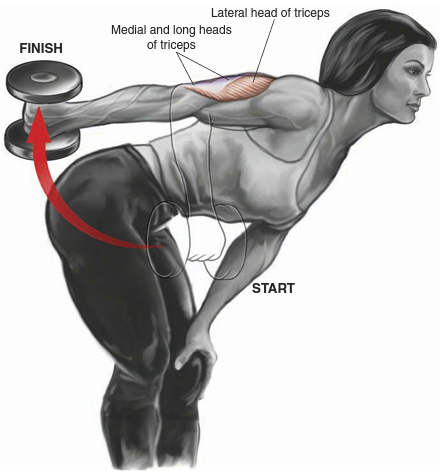
 Dumbbell Kickback

dumbbell kickback
Execution
1. Grab a dumbbell in one hand, bend forward at the waist, and support your torso by resting your free hand on a bench or on your knee.
2. Begin with your upper arm parallel to the floor and elbow bent at 90
3. Raise the dumbbell upward, straightening your arm until the elbow locks

Muscles Involved
Primary: Triceps.
Secondary: Rear deltoid, latissimus dorsi.

Anatomic Focus
Grip: A neutral grip (thumb forward) works all sections of the triceps. Rotating the dumbbell so your palm faces up targets the outer (lateral).
Trajectory: Keep the upper arm parallel to the floor and the elbow close to your side.
Range of motion: To isolate the triceps, movement should occur at the elbow, and the shoulder should remain stiff.
Resistance: Because of the effect of gravity, resistance is variable and increases as the dumbbell is raised upward.
Body position: Your torso should be slightly above parallel to the floor. If you stand too upright, you can’t perform the exerdse effectively.

 VARIATIONS
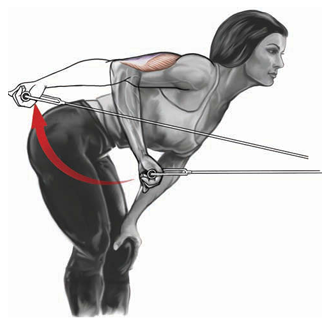
Cable Kickback
cable kickback
You can perform this exercise while using a D-handle attached to a low pulley. Unlike the dumbbell version, where the resistance varies during the lift, the cable provides a uniform resistance throughout the movement.


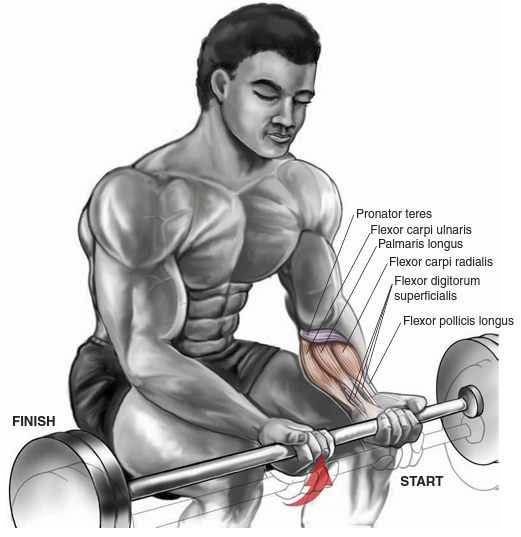
Wrist Curl

wrist curl
 Execution
1. While seated on the edge of a bench, grasp a barbell with a shoulder-width underhand grip, and rest the back of your forearms on your thighs.
2. Lower the bar by bending your wrists down toward the floor.
3. Curl the weight up by using wrist motion.

Muscles Involved
Primary: Forearm flexors.
Secondary:Finger flexors.

Anatomic Focus
Hand spacing: The ideal hand spacing is shoulder width or slightly narrower. Your hands should be directly in line with your forearms to minimize unnecessary stress in the wrist joint.
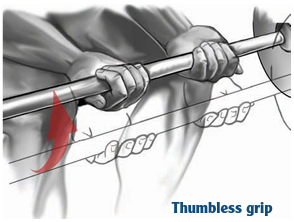
Grip: This exercise requires an underhand (supinated) grip with the palms facing upward. Your thumbs may grip under or over the bar, depending on personal preference. One advantage of a “thumbless” grip is that it allows you to lower the bar farther, increasing the range of motion.
thumbless grip
Range of motion: Letting the bar roll down your fingers during the lowering phase of the repetition increases the range of motion. As the bar is curfed upward, the finger flexors work as you finger-curf the bar into your palm, and then the forearm flexors work as you curf the wrist upward. Because the finger flexors make up a significant portion of the forearm muscles, this extended repetition is more effective for building forearm mass.
Trajectory: Changing the position of your forearms in relation to the floor alters the resistance and adjusts the focus of the exercise. When your forearms are flat and parallel to the floor, resistance is maximal at the beginning and decreases as the bar is lifted upward. When your forearms make an angle with the floor, such that your elbows are higher than your wrists, resistance is minimal at the start and increases as the bar is curled up. This second variation is more effective at maximizing forearm contraction.
Body position: Your forearms may be supported in different positions:
1. Between your legs on a flat bench
2. On top of your thighs while seated on a bench
3. On the incline pad of a preacher bench

VARIATIONS
 Dumbbell wrist curl: You can also perform this exercise one arm at a time while using a dumbbell.
Preacher bench wrist curl: Perform the exercise with your forearms resting on the incline pad of a preacher bench.

Reverse Wrist CurI

reverse wrist curl
 Execution
1. Grasp a barbell using an overhand grip, and rest your forearms on top of your thighs or on the edge of a bench.
2. Lower the bar by bending your wrists toward the floor.
3. Raise the weight up using wrist motion.

Muscles Involved
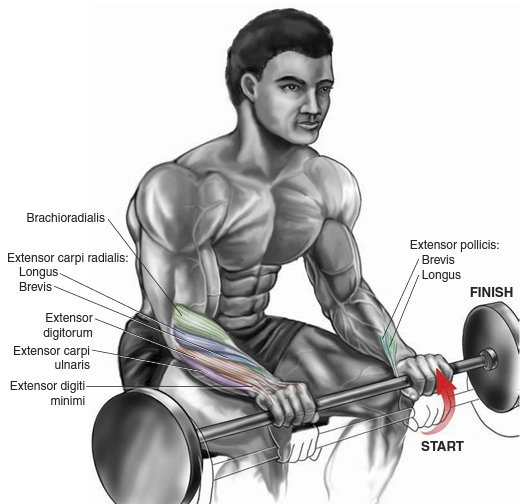
Primary: Forearm extensors.
Secondary: Finger extensors and flexors.

Anatomic Focus
Hand spacing: The ideal hand spacing is shoulder width or narrower. Your hands should be directly in line with your forearms.
Grip: This exercise requires an overhand (pronated) grip with the palms fating down and your thumbs gripped around the bar.
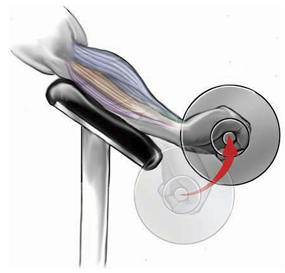
Trajectory:Changing the position of your forearms in relation to the floor alters the resistance and adjusts the focus of the exercise. When your forearms are flat and parallel to the floor, resistance Is maximal at the beginning and decreases as the bar is lifted upward. When your forearms make an angle with the floor such that your elbows are higher than your wrists, resistance is minimal at the start and increases as the bar Is curled up. This second variation is more effective at maximizing forearm
Range of motion: Use a full range of motion to maximize forearm effort.
Body position: Your forearms may be supported in different positions:
1. Between your legs on a flat bench
2. On top of your thighs while seated on a bench
3. On the incline pad of a preacher bench
4. Held parallel to the floor (unsupported) in the standing curl position

VARIATIONS
 Dumbbell Reverse Wrist Curl
You can also perform this exercise one arm at a time while using a dumbbell.
dumbbell reverse wrist curl
Additional variation:
Preacher bench: Perform the exercise with your forearms resting on the incline pad of a preacher bench.

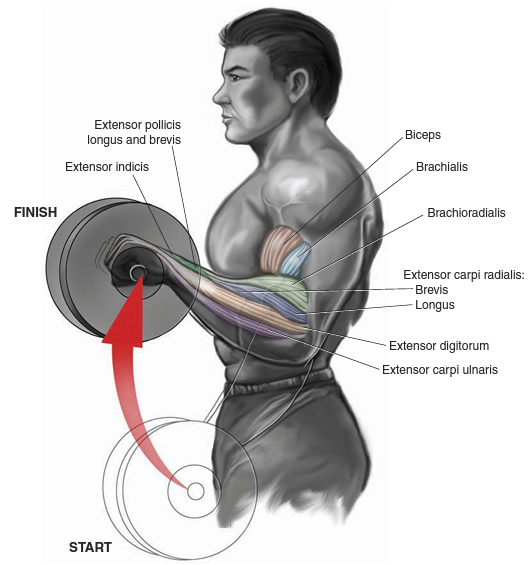
Reverse Barbell Curl

reverse barbell curl
Execution
1. Hold a barbell at arms’ length using a shoulder-width overhand grip.
2. Raise the bar up toward shoulder level, cuning your wrists up and back